Monthly commentary from the fund managers behind the Hive KiwiSaver Scheme.
Overview from Hive
August's big story was the AI and semiconductor trade powering markets through a wobble.
Global shares recovered in August as tech and chip companies regained their footing after July's sell-off, led by another strong result from Nvidia. Central banks stayed cautious throughout, and gold had a standout month as some investors hedged against America's growing debt pile.
Below, each of Hive's fund managers shares their view on what mattered in August.
Fund managers
From our fund managers
Fund manager
Aurora Capital
Market Update for August 2026
4 min read
A corporate earnings rebound, cautious central banks, and a steady NZ market.
Throughout August, global markets demonstrated remarkable resilience. Despite ongoing geopolitical tensions and mixed economic data, international stock markets bounced back strongly, driven by robust corporate earnings and continued momentum.
New Zealand Economy & Markets
Here at home, local retail sales dipped by 0.5% over the second quarter, highlighting a cautious domestic consumer. And year-on-year inflation expectations cooled from 2.5% down to 2.3% for the third quarter, signalling that price pressures are easing.
Just after month-end, the Reserve Bank of New Zealand (RBNZ) increased the Official Cash Rate (OCR) by 0.25% to 2.75%. Despite the uneven economic recovery and broader global headwinds, the RBNZ Monetary Policy Committee reiterated its confidence that domestic economic growth and employment will improve over the medium term and that tighter monetary conditions are appropriate.
Local Equities: The NZX 50 index delivered a solid 1.6% return.
Fixed Income: New Zealand government bonds were flat over the month.
Currency: The New Zealand dollar appreciated by 0.7% against the US dollar, reflecting broad weakness in the greenback.
Global Market Highlights
United States
The US economic signals were mixed in August. While business sentiment continued to improve and the unemployment rate edged down to 4.1%, annual inflation remained elevated at 3.4% and second-quarter GDP growth came in slightly lower than expected at 1.5%.
Despite these mixed economic indicators, corporate America delivered strong earnings. US shares were among the best global performers, with the S&P 500 rising 2.7% in USD. A strong earnings report from AI leader Nvidia helped restore confidence in the technology sector, though returns across large tech companies showed divergence as investors sought proven fundamental earnings over market hype.
In bond markets, US Treasury returns were up a modest 0.3% in USD. Federal Reserve Chair Warsh signalled that rates may need to stay higher for longer, as recent inflation data hadn't improved enough. However, the US Treasury balanced market expectations by announcing an unexpected increase in long-term bond buybacks, helping stabilise longer-term interest rates.
Europe
Eurozone economic data was largely in line with expectations, showing Q2 economic growth at 0.9% and annual inflation at 2.9%. European markets saw modest gains, with the STOXX Europe 600 index edging up 0.5% in EUR, aided by the global rebound in technology and growth stocks. European government bonds lost 0.6% in EUR as bond yields rose, particularly in France due to upcoming budget negotiations.
Japan
Japanese equities were a standout performer, rising 3.9% in JPY, supported by demand from US AI data centre infrastructure and a weaker Japanese yen. Conversely, Japanese government bonds declined 0.9% in JPY as longer term yields reached multi-decade highs amid rising domestic inflation.
Commodity Markets
Agricultural commodities saw notable price gains, led primarily by wheat, amid concerns over supply disruptions in Eastern Europe and building El Niño weather patterns. Meanwhile, Brent crude oil remained around the 90 USD per barrel, with ongoing geopolitical tensions in the Middle East. Elevated commodity prices could eventually fuel higher inflation, potentially leading central banks to keep interest rates higher for longer.
Portfolio Strategy
The market movements in August reinforce one of our core investment principles: diversification remains one of the most effective tools for building and protecting long-term wealth.
A broadening AI rally, a cautious Fed, and Harbour's outlook for what's next.
Key market movements
Global equities rebounded in August with the MSCI ACWI (NZD unhedged) returning 2.0%, and the NZD-hedged flavour of the same index returning 2.3% over the month. Returns on a trailing 12-month basis remain healthy, sitting at 22.0% and 21.1% respectively.
The New Zealand market was also up on the month, with the S&P/NZX 50 Gross Index (including imputation credits) returning 1.7% over the month. Australian equities were also positive, with the S&P/ASX 200 Index up 1.5% in Australian dollar terms, and a weakening New Zealand dollar contributing to a 2.8% return in NZD terms.
Fixed income returns were broadly flat. The Bloomberg NZ Bond Composite Index returned 0.1%, while the Bloomberg Global Aggregate Bond Index (hedged to NZD) ended the month at 0.0%.
Key developments
Global equities recovered in August as economic activity remained firm and company earnings continued to support markets. Technology regained momentum after July’s sell-off, although leadership was broader than semiconductors, with software companies also benefiting from solid results. Resources joined the advance as precious and industrial metals moved higher. The backdrop was not uniformly benign. Tension in the Middle East kept oil markets unsettled, while disruption risks supported agricultural commodities and European natural gas prices. Corporate fundamentals nevertheless proved resilient enough for equities to absorb both the geopolitical uncertainty and higher bond yields.
The message from Jackson Hole was less reassuring for bond investors. Federal Reserve Chair Kevin Warsh made clear that inflation remains the priority and that stronger evidence of progress towards target will be needed before the Fed can contemplate a softer policy stance. This landed against an economy that continues to perform well, leaving the Fed with less reason to look through inflation than some other central banks. Yields remained sensitive to policy rhetoric and energy prices, although the US Treasury’s plans to increase longer-dated bond buybacks provided some support at the long end of the curve.
China continues to operate at two speeds. Exports and industrial activity are benefiting from AI-related demand, but the household economy remains subdued as falling property prices and employment concerns weigh on confidence. Authorities appear prepared to accept a slower expansion while this adjustment continues. For New Zealand, the distinction matters. Weak Chinese consumption does not translate neatly into weak demand for every export, and demand for high-quality protein remains supported by a growing middle class that continues to prioritise this spending.
Closer to home, restrictive monetary policy is becoming more visible in Australia, where housing activity and discretionary spending are slowing while persistent core inflation limits the RBA’s room to respond. New Zealand’s recovery is also uneven, although the mix is different. Exports, tourism and education remain the brighter areas, and business investment is beginning to recover. Households are still cautious, with a stagnant housing market, elevated unemployment and cost-of-living pressure holding back spending. The RBNZ’s early-September increase in the OCR was accompanied by a more measured signal on further tightening, reflecting that tension between inflation risk and weak domestic activity.
What to watch
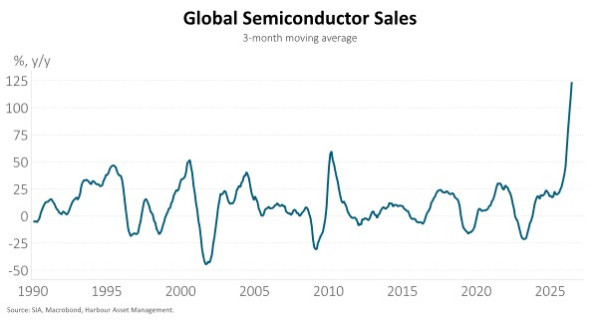
The surge in global semiconductor sales reflects the extraordinary scale of AI-related investment. NVIDIA's GPUs remain the critical compute engine behind AI models, while memory suppliers such as SK Hynix have become equally important as demand for High Bandwidth Memory (HBM) accelerates. What began as a GPU story has evolved into a broader semiconductor cycle encompassing memory, storage, networking and advanced packaging. Hyperscaler capital expenditure growth rates are still rising. As Jensen Huang recently noted, demand is continuing to outstrip supply in key AI components, with bottlenecks in production more likely to be the limiting factor for sales.
Source: SIA, Macrobond, Harbour Asset Management.
Market outlook and positioning
Economic resilience and solid earnings have allowed global share markets to withstand higher bond yields so far. That has surprised many investors. Markets entered the year worried that tighter monetary policy and elevated valuations would constrain returns, yet earnings growth has remained strong and broadened beyond a small group of technology stocks. August was a good example. Software companies participated alongside semiconductors, small caps outperformed, and earnings strength extended into areas such as energy and materials. We think that broadening is important. Markets driven by a wider group of companies and sectors are generally healthier than those dependent on a handful of leaders. Higher yields do raise the hurdle for valuations, but they may also reflect firmer growth and improving productivity rather than inflation alone. Having said that, the range of outcomes remains wide.
A solid New Zealand earnings season provided cause for some confidence on select company prospects, although there is little evidence of a broad domestic recovery. Cost reduction and productivity programmes are beginning to produce better operating leverage as even modest revenue growth moves ahead of costs. Balance sheets generally remain sound, and dividend announcements were supportive. Management guidance was still conservative, reflecting mixed activity and wider geopolitical uncertainty. With market earnings expectations modest, some of that caution may eventually prove excessive, particularly for businesses already doing the operational work needed to lift returns.
Australia looks less straightforward despite the generally constructive global backdrop. Resources and selected healthcare and technology businesses retain useful earnings support, while domestically exposed companies are contending with slower housing activity, cautious consumers and higher funding costs. Reporting season showed that headline earnings growth can obscure a weaker underlying trend when much of the improvement is concentrated in mining. We expect earnings outcomes to diverge further as restrictive monetary conditions work through the economy. That should create opportunities, but broad market exposure offers less protection when valuations remain elevated and earnings forecasts are being revised lower. The case for selectivity is stronger than the case for the market as a whole.
For the equity growth funds, our approach remains to be patient, selective and positioned for a range of potential outcomes. We continue to favour companies capable of delivering earnings growth that is both stronger and more durable than market expectations imply. Over the medium term, we expect structural forces such as digitisation, demographic change, deglobalisation and the transition in energy systems to remain important drivers of company earnings, even if the path is not always linear. In that context, the portfolio retains an overweight position in healthcare, where we see attractive opportunities across New Zealand retirement villages and Australian pharmaceutical and diagnostic businesses with long-duration growth characteristics. We also remain overweight financials, reflecting exposure to companies such as Infratil, AMP and Macquarie that may benefit from data centre investment, alternative energy development and improved transaction activity. Within consumer staples, we continue to see upside in businesses such as a2 Milk and Scales, where company-specific drivers may support earnings growth. Offsetting these positions, the portfolio remains underweight utilities, communication services and real estate. In each case, we see a less compelling balance between valuations and earnings prospects, with gentailers facing higher earnings uncertainty, telecommunications operating in a competitive environment, and property companies generally offering more modest growth outlooks.
In fixed interest, the market has taken a degree of comfort from the Reserve Bank’s almost excessively explicit intent to hike in December and then again in 2027. This modest hiking path implies some value in market yields across 1 to 3 year maturities, where expectations for rate hikes sit closer to 4%. We are being circumspect about investing into this idea, as scope for higher global yields can spill over into the domestic market. Long-term bond yields globally have continued to face pressure from a combination of large fiscal deficits, elevated government borrowing requirements and concerns that inflation may prove more persistent than central banks currently anticipate. Given this backdrop, portfolios continue to maintain a defensive bias towards long-dated duration exposures and retain short positions in parts of the longer end of the yield curve.
In multi-asset funds, we are modestly overweight growth assets. This is composed of a meaningful overweight to global equities that is partially offset by an underweight to Australasian equities, based on relative earnings prospects. We feel global equities should outperform Australasian equities given the US (which makes up almost 70% of the MSCI ACWI) has much better earnings and economic momentum. We remain underweight global fixed income where there is greater fundamental support for higher yields. We are neutral NZD as the currency appears close to fair value on our short-term model.
In the Income Fund, we have been retaining our core views for some time. We are holding a slightly underweight equity allocation, while the fixed interest strategy aligns with that being applied in our other fixed interest portfolios. Active positions include being overweight the NZ Dollar versus the Australian Dollar and also retaining holdings in inflation-indexed bonds. At a broad level, wariness about the scope for higher global long-term bond yields is behind a strategy that has been cautious over recent months.
This publication is provided for general information purposes only. The information provided is not intended to be financial advice. The information provided is given in good faith and has been prepared from sources believed to be accurate and complete as at the date of issue, but such information may be subject to change. Past performance is not indicative of future results and no representation is made regarding future performance of the Funds.
Fund manager
Pie Funds
Market Update August 2026
4 min read
Gold's rally, rising rates and the AI hardware trade.
Markets continue to move through a noisy period, with rising interest rates, a gold rally and the AI hardware trade all shaping investor sentiment.
This month Pie Funds Founder and Chief Investment Officer Mike Taylor and Kent Williams, Head of Global Equities, discuss what's driving markets - and where they're seeing opportunities.
Rates, gold, and the “debasement trade”
Chief Investment Officer Mike Taylor says the political noise this month - tariffs, conflict in the Middle East - mattered less to markets than a more familiar force: interest rates creeping higher around the world. In the US, the Treasury Secretary tried to talk yields down, including floating the idea of the Treasury buying longer-dated bonds itself. It worked for about 48 hours before yields resumed climbing.
The flow-on effect was a strong month for commodities, gold in particular. Investors have increasingly framed this as a “debasement trade” - a bet that the US is effectively debasing (or deliberately lowering the value of) its own currency against other assets. Gold has been the biggest beneficiary, bouncing hard through August after coming off its highs between May and mid-July; Bitcoin has rallied on the same theme.
That's flowed through directly to Pie's Australasian funds, which count gold and resources among their key exposures. After a tough 12 months or so, they've had a better month so far in August. “A lot of it has been driven by resources,” he says, pointing to funds like the Pie Emerging Companies Fund with heavy resources weightings - some gold names are up 40–50% for the month alone. It's not only gold, though: several portfolio companies have posted strong results through reporting season (which is about three-quarters complete), and some oversold software names have rallied too.
The AI hardware trade - and how to ride it without the drawdowns
Head of Global Equities Kent Williams, who's run Pie’s Global Growth and Global Growth 2 funds for around 18 months, reports both funds returned over 22% for the 12 months to the end of July (after fees, before tax) - slightly ahead of benchmark, at a time when some global active managers have significantly lagged benchmark.
Two themes have driven that: gold, and the broader AI hardware / semiconductor trade. Kent estimates the latter alone accounts for at least half of global sharemarkets’ roughly 20% return (before fees and tax) over the past year, despite AI hardware making up only 15–20% of the market by weight - a small part of the index doing an outsized share of the work, with some individual stocks up anywhere from 1,200% to 2,000% over 12 months.
Staying “market aware” - alert enough not to be caught offside by a trend like this - is central to Kent's process. But riding the trade hasn't meant taking on maximum risk. When semiconductor stocks fell around 20% in July, the Pie Global Growth Fund still outperformed the benchmark. Kent puts that down to portfolio construction: staying overweight the AI hardware theme, but deliberately avoiding the riskiest, least profitable and most expensive names within it, in favour of a blend built to deliver more consistent returns through the cycle.
Information is current as at 25 August 2026. Past performance is not a guarantee of future returns. Returns can be negative as well as positive and returns over different periods may vary.
Fund manager
Munro Partners
1 min read
Equity markets held steady despite a fresh AI and semiconductor sell-off, and Fed rate uncertainty.
August saw equity markets hold steady in spite of the recent AI sector sell-off and some late-month volatility, driven by ongoing geopolitical conflict and the Fed declining to rule out a September rate hike. Despite a difficult short-term backdrop driven by political sentiment, Munro remains confident in AI being a structural driver over the medium term, reinforced by Nvidia’s earnings where demand continues to be very strong.
Key contributors to performance for the month were Nvidia (Energy Efficiency), Vestas Wind Systems (Clean Energy) and Cameco (Clean Energy).
Key detractors from performance for the month were GE Vernova (Clean Energy), Quanta Services (Clean Energy) and Nextera Energy (Clean Energy).