Market commentary from the fund managers behind the Hive KiwiSaver Scheme.
Overview from Hive
October’s big story was a sell-off in AI shares, with investors turning to more traditional businesses.
Worries about the huge cost of building AI data centres hit technology shares, and emerging markets in Asia fell the furthest. Global shares dipped as a result, while many traditional and defensive businesses held up better. Oil climbed towards US$120 a barrel before easing, and bond yields came off their recent highs, which helped bonds rise. Closer to home, New Zealand shares slipped only slightly. The Reserve Bank of New Zealand surprised markets by holding the Official Cash Rate at 2.75%.
Below, each of Hive’s Fund Managers shares their view on what mattered in October and what they’re watching next.
Fund managers
From our fund managers
Fund manager
Aurora Capital
Market Update for October: Sector shifts, easing NZ inflation, and bond gains
3 min read
Investors moved money out of technology shares and into traditional businesses.
October brought important shifts across world financial markets, with investors moving out of technology shares and into more traditional businesses. Here’s what happened overseas, how New Zealand fared, and how we’re thinking about the months ahead.
Global Overview: Sector Shifts and Energy Pressures
Global shares fell modestly in October. The broad global share market dropped 1.4% in NZD terms.
However, this headline figure masked a major shift beneath the surface. Investors moved money out of technology shares and into traditional businesses. Value shares rose 2.9% compared to growth shares which fell 4% (both in NZD terms).
Technology shares struggled after earlier strong gains. Investors questioned the heavy spending required for artificial intelligence data centres. In the US, the tech-heavy Nasdaq fell 5.3% (USD) and the S&P 500 slipped 0.9% (USD). The equal-weighted S&P 500, which gives every company the same weight, rose 5.0% (USD), a sign that businesses outside big tech did well.
Meanwhile, Middle East tensions pushed oil prices higher. Brent crude, the global oil price benchmark, reached USD 118 per barrel and marked a 3.7% monthly rise in USD terms.
Overseas Growth and Persistent Inflation
Major foreign economies expanded steadily during the third quarter. The US economy grew at an annualised rate of 3.4%. In the Eurozone, economic growth reached 1.3% compared to a year earlier.
However, inflation remained persistent across major economies. US consumer prices rose 3.7% in September compared to a year earlier. In the Eurozone, 12 month consumer price inflation reached 3.8% in September.
Sticky inflation kept pressure on global borrowing costs. Several central banks lifted their benchmark interest rates by 0.25%. The Bank of Canada raised its benchmark rate to 2.5%. The Reserve Bank of India lifted its rate to 5.5%. In the first week of November, Australia and the UK both raised their rates.
New Zealand: Cooling Inflation and Local Resilience
Global trends directly influence New Zealand. Higher international oil prices can lift local fuel and shipping costs. High interest rates overseas also keep world borrowing conditions firm.
However, domestic updates brought welcome news for Kiwi investors.
Most importantly, New Zealand inflation cooled significantly in the third quarter. Consumer prices rose just 0.7%, well down on the 1.5% rise in the previous quarter, and food prices were flat in September.
Lower inflation gives the Reserve Bank of New Zealand room to adjust the Official Cash Rate (OCR). The OCR is our central bank’s main benchmark interest rate that guides mortgage rates and business lending. Easing inflation can provide indirect relief to local households and mortgage holders.
Local business activity also showed steady strength. The BusinessNZ manufacturing index rose to 56.5 in September and the ANZ business confidence measure climbed to 52.5 in October, with anything above 50 pointing to growth and optimism.
Domestic Market Performance and Bonds
New Zealand assets held up well against global volatility.
The New Zealand S&P/NZX 50 Gross Index slipped just 0.3%. In Australia, the S&P/ASX 200 index rose 1.4% in AUD terms. The New Zealand dollar weakened 0.2% against the US dollar.
High-grade bonds delivered strong positive returns. Government bond yields fell globally, which pushed bond prices up. Global bonds gained 1.6% in NZD terms. New Zealand government bonds gained 1.5%. US government bonds returned 2.4% in USD terms.
Looking Ahead
Market rotations can feel unsettling in the short term. However, October proved the enduring value of a diversified strategy.
Our portfolios spread risk across different asset classes, sectors, and countries.
A sharp sell-off in AI-linked technology stocks and emerging markets outweighed gains elsewhere.
Key market movements
Global equities fell in October, with the MSCI ACWI returning -1.4% in NZD-unhedged terms and -1.6% in NZD-hedged terms. A sharp sell-off in AI-linked technology stocks and emerging markets outweighed gains elsewhere.
The S&P/NZX 50 Gross Index (including imputation credits) returned -0.3%, largely due to weakness in Infratil. Australian equities were firmer, with the S&P/ASX 200 returning 1.4% in Australian dollar terms and 2.7% in New Zealand dollar terms.
Bond markets rallied as yields fell and investors sought diversification. The Bloomberg NZ Bond Composite Index returned 1.4%, and the Bloomberg Global Aggregate Bond Index (hedged to NZD) returned 1.6%.
Key developments
The defining feature of October was a poor conversion of AI revenue into cash flow, and a sharp rotation of funds from AI-related exposures to lagging defensive equity sectors and investment-grade bonds. Developed equity markets slipped 0.8%, as weakness in some of the largest US technology companies outweighed broad-based gains across other sectors.
The real damage was in emerging markets, which fell 8.0%, and in stocks linked to artificial intelligence (AI). Investors grew more sceptical that the sums being committed to AI infrastructure would earn an adequate return, and higher financing costs weighed on the more heavily indebted parts of the ecosystem. Technology-heavy Asian markets such as Korea took the brunt of the sell-off, with growing Chinese competition adding to concerns over the upfront capital tied up in the data-centre buildout. Local politics unsettled some markets too. Political uncertainty and France's fiscal outlook kept French stocks under pressure, while Brazilian equities fell by nearly a fifth following the presidential election result. The subsequent sharp rebuke of the US Republican Party at the midterms has accelerated questions around the build-out speed of data centres. A slower build out could create a bottleneck in the US for land, power and data centre buildings (“shells”). In essence, this could potentially reduce demand for semiconductors.
US inflation remains uncomfortably high and likely requires further Federal Reserve (Fed) rate hikes, despite signs of moderating economic activity. September headline and core US CPI inflation surprised to the upside. While oil prices approached US$120/barrel during the month, the subsequent fall in oil prices may lessen further inflation pressure.
The US labour market continues to show strong jobs growth, leaning the Fed to a hawkish stance despite leaving its policy rate unchanged at 3.75–4.00% in October. In the press conference, Fed Chair Kevin Warsh emphasised that economic growth, employment and investment remain strong while inflation is still too high, making price stability the Fed’s clear priority. The Fed nevertheless chose to wait for more information before tightening again, arguing that September’s increase is already tightening financial conditions and that stronger productivity may be allowing the economy to grow faster without generating equivalent demand-driven inflation.
Global interest rates dropped notably during October but remain elevated. US 10-year real yields were close to 3% in early October, but signs through the month that the higher cost of credit was beginning to have an impact on AI financing and interest-rate-sensitive sectors saw them finish the month around 2.6%. Yields remain elevated, however, with short-term interest rates reflecting restrictive monetary policy in response to high inflation. Long-term interest rates continue to be influenced by large government financing requirements and increased corporate issuance associated with AI investment.
Growth across Asia remains mixed. China continues to operate as a two-speed economy with exports and manufacturing significantly outperforming the housing market and consumption. Aggregate growth remains relatively robust at c.4.5%. Australia, meanwhile, has started to show evidence that earlier monetary tightening is affecting domestic demand, but persistent core inflation pressures supported further monetary policy tightening from the Reserve Bank of Australia in early November that took the cash rate to 4.85%.
The NZ election in early November was a close contest, and at the time of writing the composition of the next government is still uncertain despite the current coalition holding a slim one-seat majority on the election night numbers. While a period of uncertainty could place a risk premium in markets, the broad sweep of macro trends is unlikely to change from a continued need to bring down inflation.
And while New Zealand's inflation data improved at the headline level during October, the underlying picture was less encouraging. Annual CPI inflation declined to 3.7% from 4.1%, but several core measures increased. Domestic economic conditions continue to suggest a disinflationary offset. Business confidence has improved, but firms' reported activity remains subdued and insufficient demand continues to constrain many businesses. Household spending and housing are soft, wage growth is contained and spare capacity remains significant. Services activity has improved modestly, but labour market indicators remain weak.
The Reserve Bank of New Zealand (RBNZ) unexpectedly held the OCR at 2.75%, prompting a sharply dovish reaction as markets had all but fully priced a 25bp hike. The decision was finely balanced, with a 4–3 vote to hold: the majority preferred to assess the impact of the two recent hikes, noting softer-than-expected headline inflation, contained inflation expectations and wage growth, and risks to the recovery in household consumption and investment. The minority favoured an immediate 25bp hike, placing greater weight on persistently elevated core inflation, resilient growth and the risk that inflation becomes embedded in price-setting behaviour. Overall, the minutes retained a hawkish bias despite the surprise hold, with the debate centred more on the timing of further tightening than disagreement over the inflation outlook.
What to watch
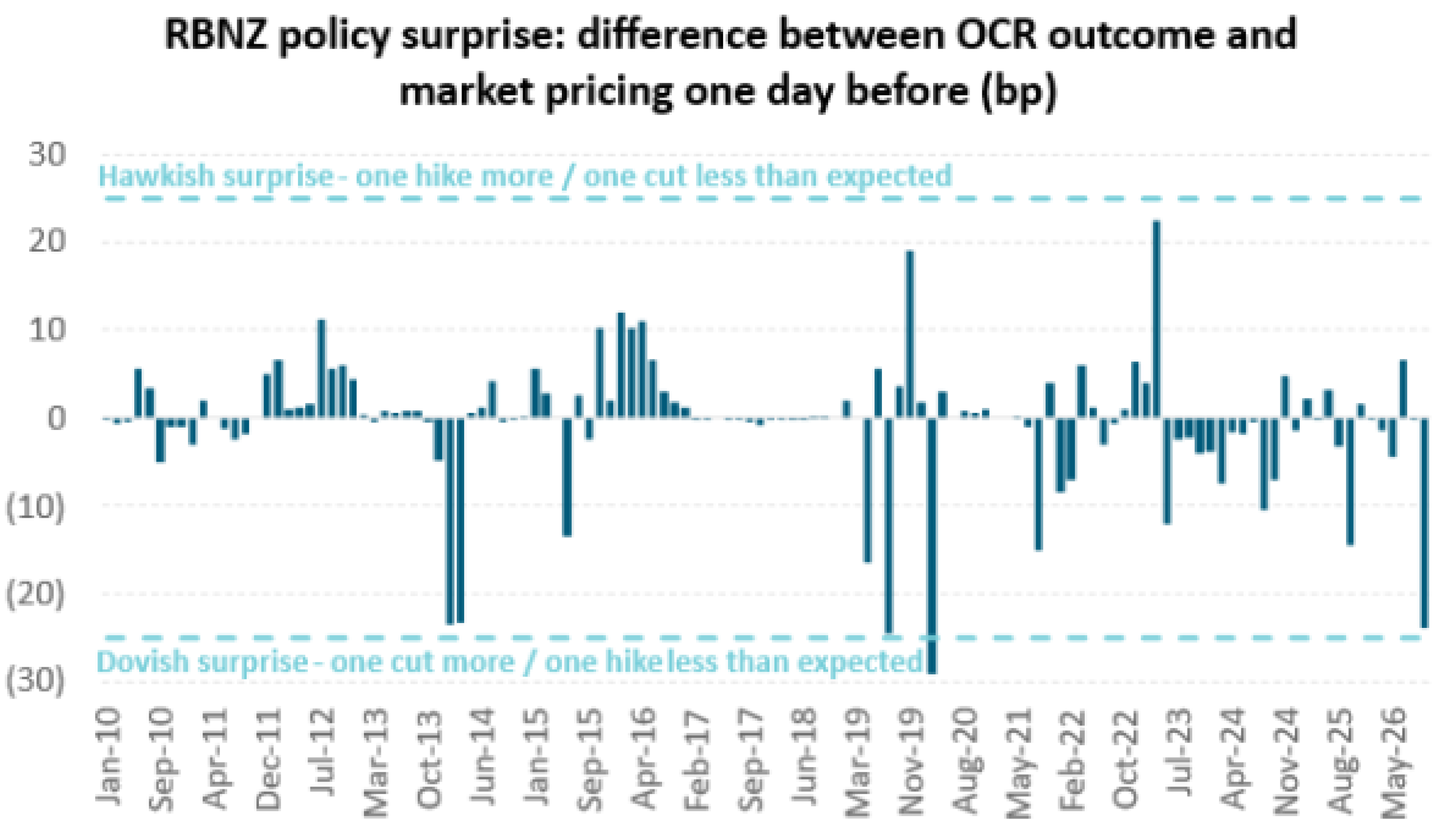
Source: Bloomberg
The RBNZ wrong-footed both financial markets and economists this week by choosing to leave the OCR unchanged at 2.75% vs. a market-implied 95% chance of a 25bp hike and 23 of 25 analysts surveyed by Bloomberg forecasting a 25bp hike. It marks the largest surprise since COVID and one of the biggest since 2010. In this context, it’s worth remembering that the RBNZ’s remit states that in pursuing its operational objective of inflation targeting, the MPC shall “seek to avoid unnecessary instability in output, employment, interest rates and the exchange rate.” This week’s decision seems to have placed much more weight on the former two variables of output and employment, rather than the latter two.
Market outlook and positioning
We expect global markets to be more volatile from here, with investors less willing to pay for growth expectations and more focused on whether companies can actually deliver earnings and cash flow. Questions on the changing US political landscape in key data centre states are one key factor. Global growth should stay moderate into 2027, and the US economy in particular remains resilient. However, persistent inflation and elevated bond yields have raised the hurdle rate for capital at a time when investors are asking harder questions about the return on AI infrastructure spending. Recent weakness in crowded technology positions reflects that scrutiny, and it has encouraged a rotation into previously overlooked sectors such as healthcare, infrastructure and consumer staples. With higher financing costs and uncertainty over monetary policy likely to constrain equity valuations, we think returns will become increasingly differentiated across companies. Those with pricing power, strong balance sheets and visible earnings growth, and which can fund their expansion internally, should be better placed.
Closer to home, the New Zealand and Australian markets offer quite different prospects. New Zealand's headline valuation still looks full, with the market trading around 24 times forward earnings, a little above its five-year average. That figure is skewed by the largest companies though. The median company trades around 16.5 times forward earnings, below its historical average, with a gross dividend yield of around 6%, and we see that gap as the main source of opportunity. Earnings expectations for the NZ market are low, so even a modest improvement in domestic activity could lift earnings and share prices. However, interest rates and the general election remain risks for infrastructure, utilities, housing and retirement villages. Australia looks harder going in the near term. Earnings forecasts are still being cut, while sticky inflation is pushing the RBA towards further tightening. Despite this, the S&P/ASX 200 has re-rated to around 17.7 times forward earnings – a 7% premium to its 10-year average. The better opportunities there are likely to be in infrastructure, listed property and healthcare, which could benefit from an eventual move to lower interest rates during 2027.
Meanwhile, fixed-interest markets have been displaying reassuringly haven-like qualities. After a tough few months of rising yields the market has turned around, reflecting a sense that fiscal deficits, higher inflation and very large borrowing requirements from hyperscalers are now adequately priced in. The post-US election drop in oil prices is taking the edge off inflation fears and investors have switched their mindset. US 10-year yields have already declined by 0.5%. The market is perhaps fairly priced rather than cheap, but to us, it does seem a market that we can take some comfort investing into.
For the equity growth funds, our strategy remains patient and selective, positioned for a range of scenarios with a focus on growth. We look for companies delivering earnings per share growth, particularly where that growth could be higher and last longer than consensus expects, and we continue to see the secular tailwinds of digitisation, decarbonisation, deglobalisation and demographic change supporting company earnings. Relative to benchmark sector weights, Harbour's growth funds are overweight healthcare, through New Zealand retirement villages, where returns may improve as supply and demand stabilise and operating efficiency lifts, and Australian pharmaceutical and diagnostics businesses whose world-class products support long-term growth. The funds are also overweight financials, where Infratil is positioned to benefit from growth in data centres and alternative energy, and Challenger and Macquarie may benefit from stronger transaction activity. In consumer staples, a2 Milk may deliver better returns as it rebuilds its market share in China, while Scales has growth potential in its horticulture and proteins businesses. Conversely, the funds are underweight utilities, where gentailer valuations appear full amid rising earnings risk. They are also underweight communication services, where competition in telecommunications is elevated and valuations are full relative to modest earnings growth. This concern is also keeping real estate underweight.
In fixed interest, we had held a positive view, based on the assessment that the market was anticipating more OCR hikes than we judged to be likely. In early November, following the fall in oil prices immediately after the US election and the weak NZ jobs data released on the same day bond yields fell, having already declined over the previous fortnight. Market pricing for the OCR rate by late 2027 has declined from 3.9% to 3.6%.
From here we see the market closer to fair value. The fall in oil prices, if sustained, does suggest that the surge we expect to see in inflation data may be short-lived. However, with core inflation still running closer to 2.6% we think it will be difficult to get inflation to the RBNZ's target level at 2%. A driver of our rationale is that supply-side drivers of inflation will persist, partly due to geopolitical dynamics and partly due to other structural issues. In January, we will most probably see headline CPI rise to around 4.5%. The net effect of these inflationary crosscurrents may bring a bond market that does not find reason to move far in either direction, effectively delivering returns close to prevailing market yields.
In multi-asset funds, we reduced our overweight to global equities last week in response to a mixed earnings season such that our overall growth allocation is underweight. We continue to feel global equities should outperform their Australasian counterparts based on better earnings prospects and relative economic momentum, but have tempered this view. We remain overweight global fixed income, the position funded via an underweight to domestic fixed income. We prefer global bonds due to their generally higher yield and longer duration vs. domestic bonds, allowing them to likely provide better portfolio protection in the case of a negative demand shock. We have more NZD hedging relative to benchmark with the recent NZD/USD drop to 0.56 taking it further below our short-term estimate of fair value.
This publication is provided for general information purposes only. The information provided is not intended to be financial advice. The information provided is given in good faith and has been prepared from sources believed to be accurate and complete as at the date of issue, but such information may be subject to change. Past performance is not indicative of future results and no representation is made regarding future performance of the Funds.
Fund manager
Pie Funds
A spooky October, but the bull isn’t broken.
5 min read
October’s volatility ran deeper than the headline numbers suggested. In his monthly update Mike Taylor discusses why the AI trade is growing up, what Anthropic’s IPO tells us, and two elections in one week.
Happy Halloween
October has lived up to its spooky reputation. Mark Twain put it best:
"October. This is one of the peculiarly dangerous months to speculate in stocks. The others are July, January, September, April, November, May, March, June, December, August and February."
More going on under the surface
October reminded investors that markets don't go up in a straight line. What I find interesting is that the volatility underneath markets has been much greater than the headline numbers suggest. Some of the most crowded trades have been hit hard.
My read is that the bull market isn't broken, but risk appetite has taken a knock. There has been a lot of leverage and momentum in parts of the market, and some of that is now being washed out. That's healthy longer term. But I wouldn't rush to call the bottom. Not until oil has peaked.
The good news is that rates are off their highs. Last month I said that if the pressure on rates eased, bonds and rate sensitive shares could bounce quickly. My bet looks good for now. The one that worries me is French bonds, and I'm watching them closely.
The AI trade grows up
Is the AI trade slowing? Yes, but there's an important distinction. The investment cycle isn't slowing. Companies are still spending enormous amounts on AI infrastructure. What is slowing is investors' willingness to pay any price for that growth.
Funding is also getting harder. Credit spreads are widening, and the market is forcing the likes of Meta to raise equity rather than go to the bond market. That's quite a turn, only a month after Muse sent its shares up 36%.
The market is now saying: show me the return on all this capex. That's a big change. We've gone from everything AI going up together to investors being much more selective. Companies with real earnings, cashflow and demonstrable returns will be rewarded. Those relying on the story alone could struggle.
I suspect the easy money in the AI trade has been made.
Anthropic heads to market
The other big AI story of the month was Anthropic filing for its IPO, with a proposed Nasdaq listing under the ticker ANT. I really like the ticker.
When everyone is really bullish on something, it makes me a bit nervous. But with Anthropic and the whole AI complex right now, it’s the opposite. There’s more than a healthy dose of scepticism around. People are climbing over themselves to be bearish.
What I like about the prospectus is the growth in enterprise. Anthropic has around 11,900 customers spending more than US$100,000, 1,900 spending more than US$1 million and 250 spending more than US$10 million. The demand is real, the revenue is real, and it's growing fast.
The concern is the cost. Anthropic has over US$800 billion of commitments to compute and infrastructure. That goes straight to the question the market is now asking of the whole sector: show me the return on all this capex. There's also been talk about a 50.1% controlling stake, the so-called God stake, but I'm less worried about that.
So is it worth at least US$1.5 trillion? I can't wait to find out.
Selective, not defensive
Investors aren't running for the exits. They're becoming more selective. Money is moving away from highly valued, long-duration growth stocks towards businesses with strong balance sheets, cashflow and predictable earnings. There has also been some fairly obvious rotation into traditional defensive areas.
One example: the equal-weighted S&P 500, where every company counts the same, is outperforming the tech-heavy Nasdaq 100. Ironically, lower rates on the back of AI growth concerns have helped the rest of the market.
That's what usually happens when confidence wobbles. Investors don't leave the market altogether. They just become much less tolerant of valuation risk and speculative stories.
A surprise from the RBNZ
I was surprised by the Reserve Bank's decision to pause. I thought another 25 basis point hike was the most likely outcome, and the market had priced it that way.
The pause is helpful for the NZ economy. It should support the rate sensitive parts of our market: smaller domestic companies, property and other businesses that have been under pressure from higher rates.
But it isn't the all-clear. It was a 4-3 decision, and the RBNZ is still signalling another hike may be needed. A weaker NZ dollar also creates another inflation problem if it persists. I suspect there was an element of not wanting to interfere, given voting in our election started that week. The next six weeks of inflation and economic data will be very important.
Two elections, one week
At the time of writing, both the US midterms and our own election are upon us.
In the US, a Democrat win in one or both houses of Congress probably means more gridlock in Washington. Markets can live quite happily with gridlock, because it limits the ability of either side to make major policy changes. I'd expect some initial volatility, but rates, oil, earnings and AI will matter far more to markets than the midterms.
New Zealand could be a little different. If we saw a change to a left bloc government, I'd expect an initial reaction in the dollar and some domestic shares while investors work through the coalition agreement, tax policy, employment regulation and fiscal settings.
But the election alone won't set the direction of the NZ market. We're a small open economy. Global markets, interest rates and company earnings will have a much bigger influence.
There could be some noise around both elections. But, I wouldn't make a major investment decision based on either result.
Growth equities retreated in October as a sharp sell-off in AI and semiconductor stocks delivered the Nasdaq its worst month since March 2025.
Growth equities retreated in October as a sharp sell-off in AI and semiconductor stocks delivered the Nasdaq its worst month since March 2025, driven by heightened concerns over funding for the AI buildout.
Key contributors to performance for the month were NextEra Energy (Clean Energy), Linde (Energy Efficiency) and American Electric Power (Clean Energy).
Key detractors from performance for the month were Siemens Energy (Clean Energy), GE Vernova (Clean Energy) and Nvidia (Energy Efficiency)